MAGLEV PID CONTROLLER
ABOUT THE PROJECT
The Magnetic Levitation (MagLev) Control System project involved modeling, designing, and testing a control mechanism to levitate a metal ball within a magnetic field. Our goal was to create a precise and robust PID-controlled system that would allow stable and dynamic levitation, maintaining or altering the ball's vertical position in response to various input signals (sine wave, square wave, and random signals). This project combined theoretical modeling, experimental validation, and software integration, particularly using LabVIEW and MATLAB.
SOLVING & TESTING
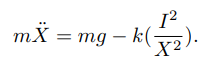
Developing a stable control system for the MagLev device required theoretical understanding and iterative empirical testing. Initially, the system was governed by a nonlinear second-order differential equation:
Linearization around the operating point simplified our control approach:
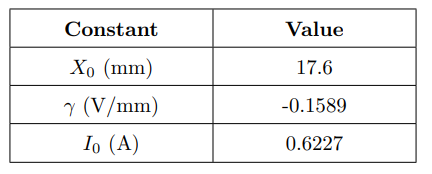
Our empirical testing began with finding the critical gamma (γ) value from the sensor voltage relationship:
Through experimentation, we found:
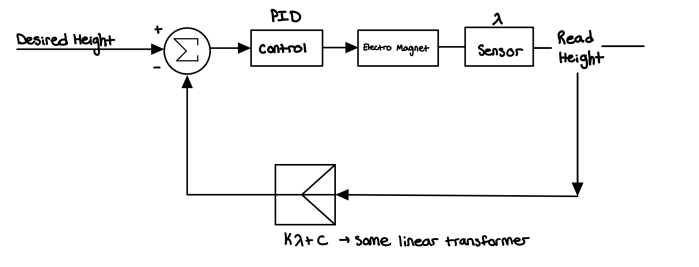
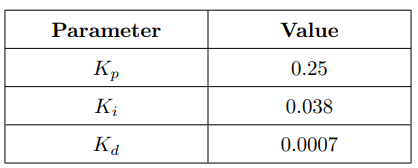
Next, employing MATLAB's SISOTool, we established a starting point for the PID parameters. Initially, we utilized a PD controller:
This preliminary stage identified stability improvements but highlighted inadequate steady-state performance. Consequently, we expanded the controller to a full PID structure:
These values significantly enhanced performance by reducing transient overshoot and steady-state error, satisfying our system requirements of less than 5% overshoot and under 0.75 seconds settling time.



RESULTS
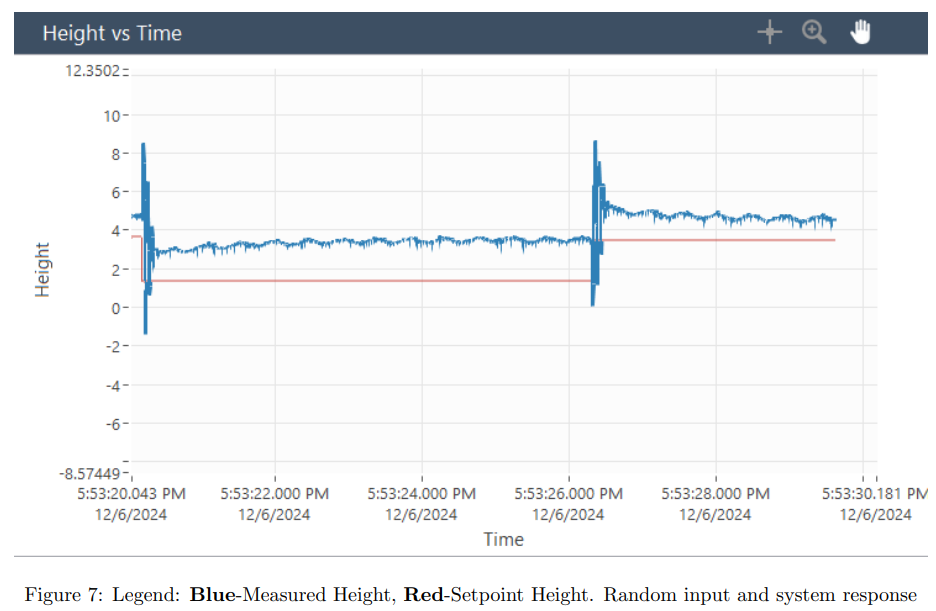
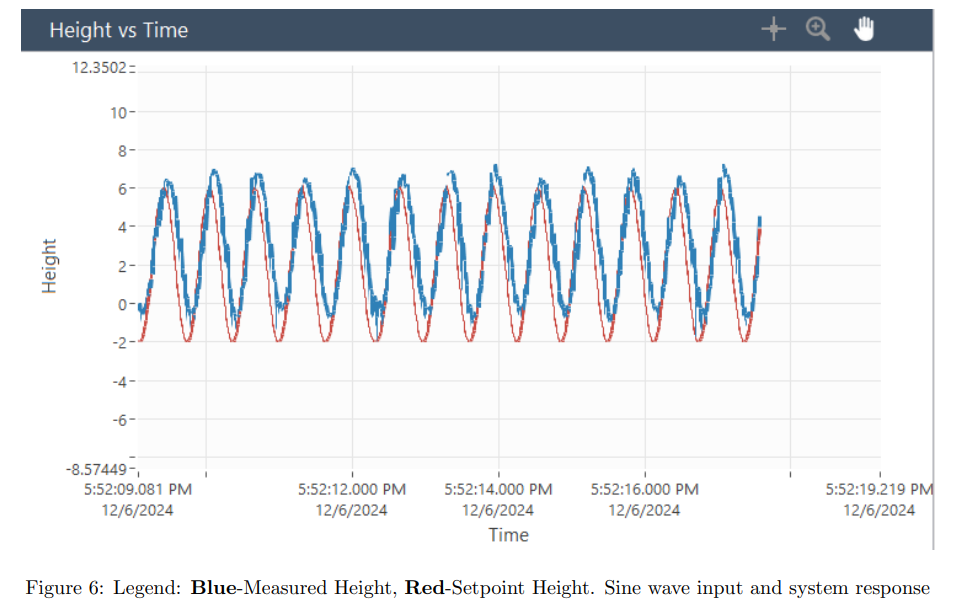
The finalized PID-controlled MagLev system successfully levitated the ball, precisely controlling its vertical position. Our LabVIEW-based interface displayed real-time parameters, including PID coefficients, sensor voltage, and positional data, alongside a graphical visualization of the ball’s height over time. The system effectively handled dynamic input signals:
Sinusoidal Inputs: Demonstrated precise tracking, maintaining consistent amplitude and frequency responses.
Random Inputs: Exhibited robust stability, rapidly correcting position despite unpredictable disturbances.
This project was personally compelling due to the complexity of theoretical control dynamics and their practical realization. Simplifying the theoretical equations into a functional PID controller and observing the transition from theory to real-world performance was rewarding. The experience deepened my understanding of advanced control systems and reinforced the value of iterative empirical tuning and methodical troubleshooting.