CANARD COMPUTATIONAL FLUID DYNAMICS RESEARCH
(Updated 7/22/2025)
This independent research study began as an opportunity to learn and apply computational fluid dynamics (CFD) for the first time, focusing on the post-burn supersonic flight of Duke AERO’s competition rocket. Under the mentorship of Professor Earl Dowell, I investigated how varying canard deflection angles affect turbulence, flow separation, and roll stability at Mach 1.72. Using ANSYS Fluent, I developed high-fidelity models of the rocket's aerodynamic surfaces and simulated unsteady flow behavior to visualize dynamic pressure, turbulent kinetic energy, and wake development. Over the summer, I extended this work by implementing a symmetric 1/3-body geometry to enable finer meshing and target y⁺ values below 5. I also quantified the aerodynamic moment generated by the canards—both manually and via Fluent—and examined how wake interactions with downstream fins influence drag and control effectiveness. This refined study reveals that even at maximum deflection (5°), the canard-generated flow remains coherent and attached, suggesting that control authority can be increased without triggering instability. The results contribute to the design of more stable and efficient steering systems for future high-speed aerospace applications.
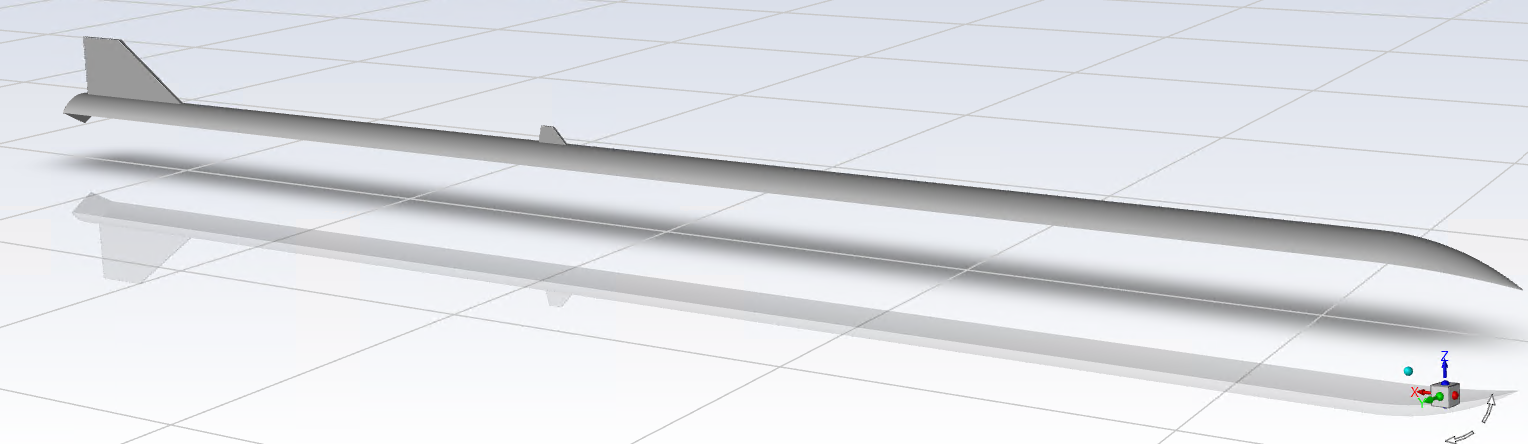
ANSYS Fluent Geometry

OnShape Assembly
The geometries shown above were created in OnShape and imported into ANSYS Fluent to simulate canard-induced aerodynamic effects in supersonic flight. To isolate these effects, the simplified model includes only the nosecone, rocket body, three rear fins, and three forward canards. Two versions of this model were developed to represent different canard deflection angles—0° and 5°—capturing the minimum and maximum operational range of the rocket’s control system.
Displayed below are the meshes used during the two main phases of this study. In the initial semester-long analysis, full-body models without symmetry constraints produced area-weighted y⁺ values of ~35–47—outside the ideal range for wall-resolved turbulence modeling. In the extended summer research, I introduced a symmetric 1/3-body domain to enable finer mesh refinement.
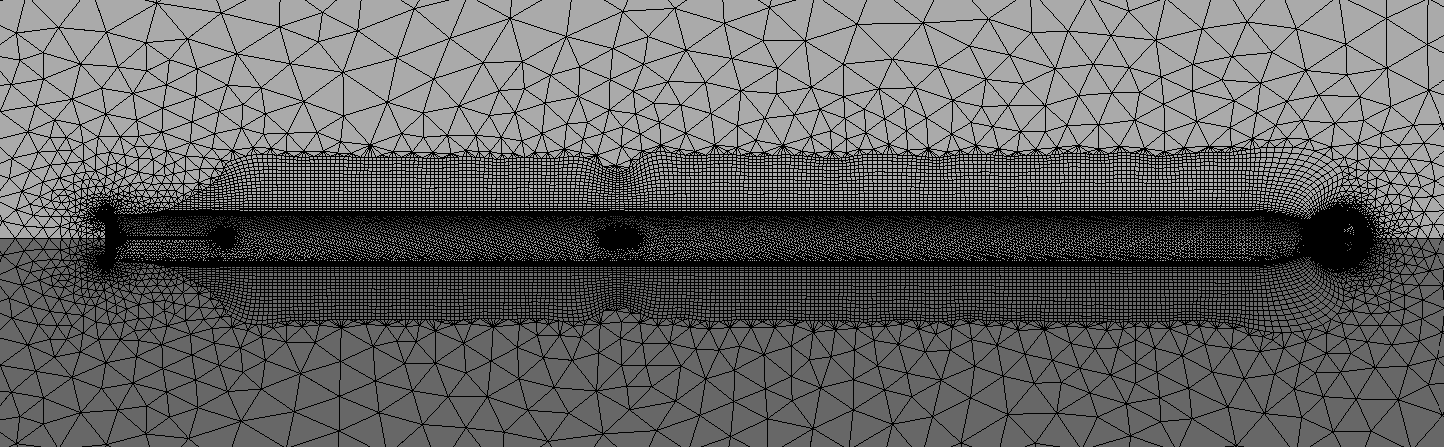
ANSYS Fluent 0 Degree Mesh
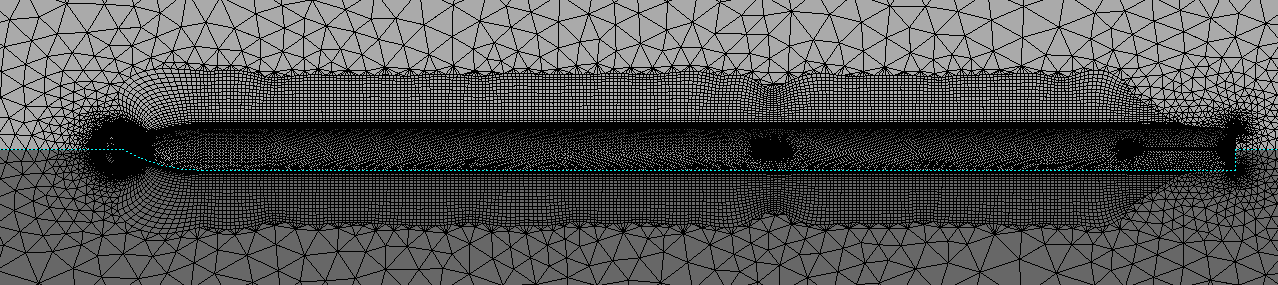
ANSYS Fluent 5 Degree Mesh
MOMENT & DRAG RESULTS
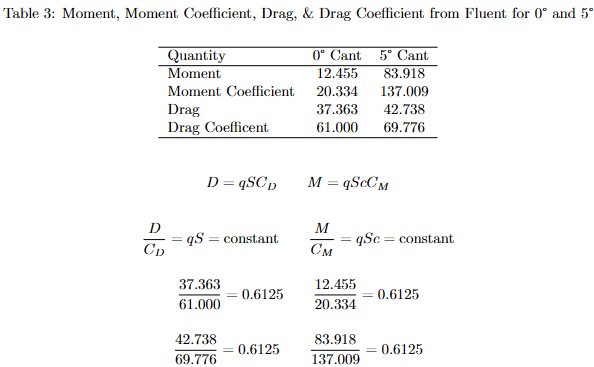
The near-equal values of D/Cd and M/Cm at both 0° and 5° canard deflections reveal a strong linear relationship between drag and pitching moment. This confirms that the flow over the canards remains stable and attached, even at our mechanical maximum deflection. Like pre-stall behavior in airfoils, this linearity suggests that 5° lies within a controlled regime—ideal for aerodynamic stability and control authority. Future testing beyond 5° would help identify when flow separation or unsteady effects such as LCO begin to emerge.
CFD RESULTS
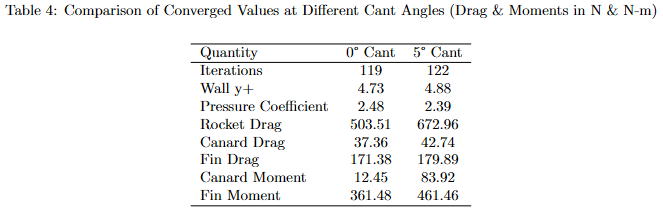
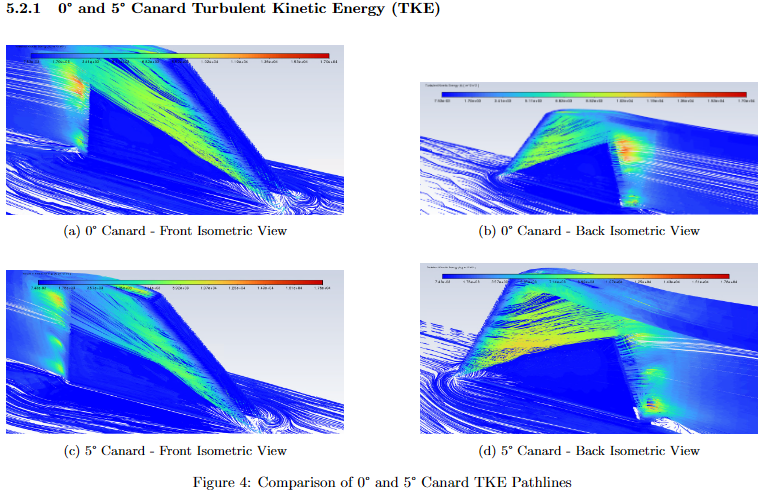
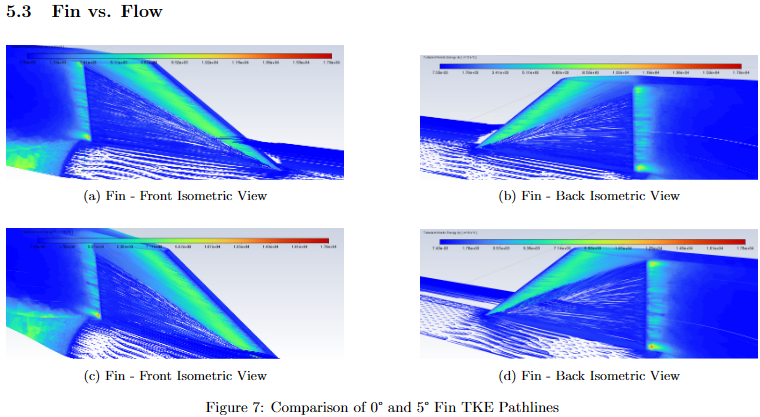
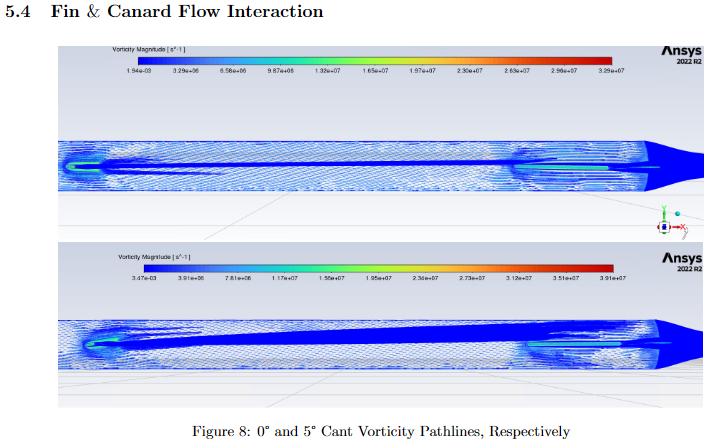
This study compares the aerodynamic effects of 0° and 5° canard deflection angles on Duke AERO’s rocket during post-burn supersonic flight. Using high-resolution meshes (y⁺ ≈ 5), CFD simulations captured turbulent kinetic energy (TKE) pathlines that reveal clear differences in wake behavior. At 0°, the flow remains relatively stable with minimal downstream disturbance. At 5°, the canards generate a stronger and more coherent vortex structure, significantly increasing both drag and pitching moment—without signs of flow separation or instability.
The data show a sixfold increase in canard moment and a 33% increase in drag at 5°, confirming enhanced control authority at the cost of slightly higher aerodynamic penalty. However, the linear relationship between drag and moment suggests the flow remains in a stable pre-stall regime, and deflection beyond 5° would be required to probe the onset of flow separation or stall-like behavior.