SPEED DRONE
BACKGROUND
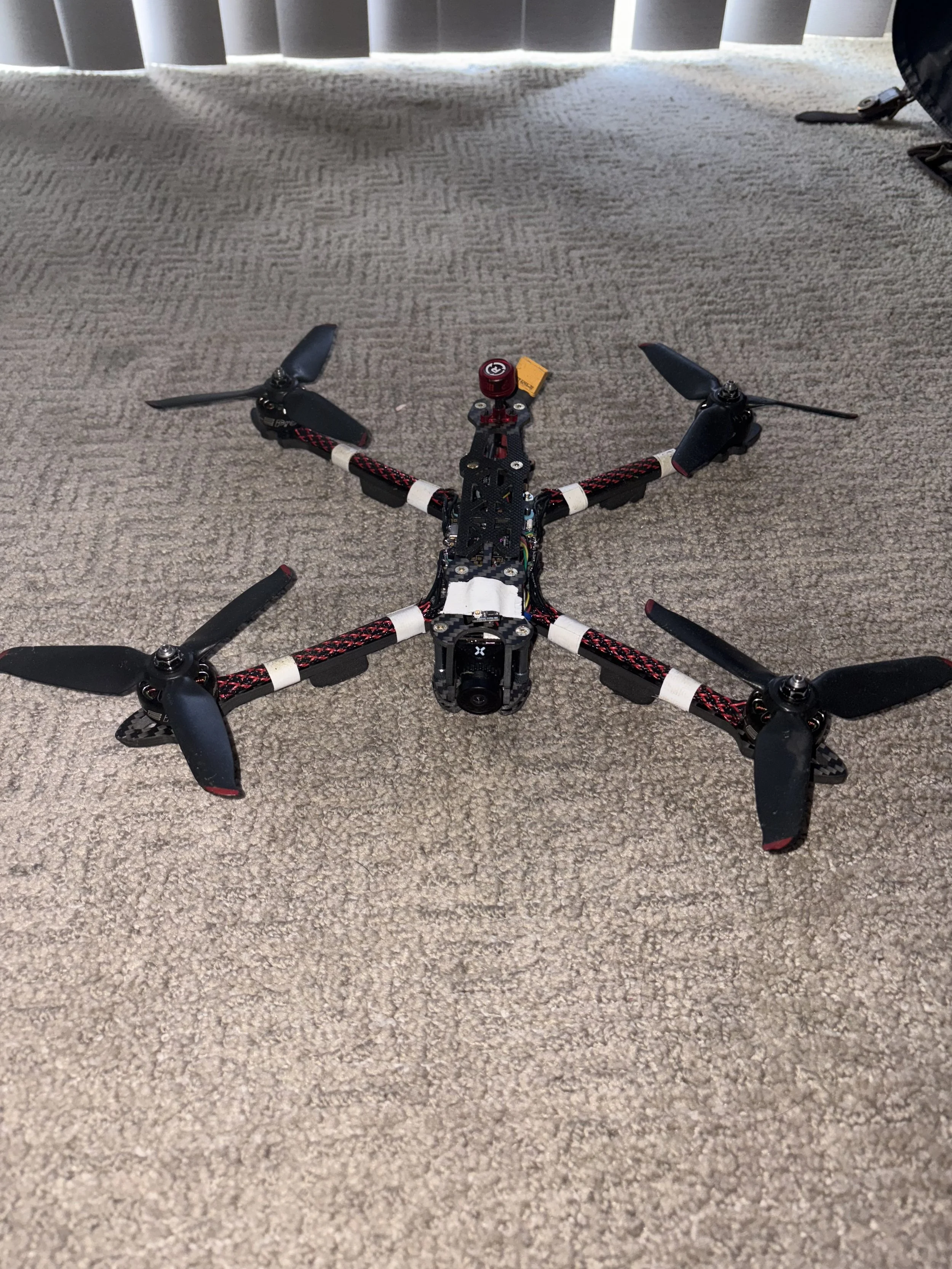
Before this project, I had never worked with drones and didn’t have close friends involved in RC hobbies, so this drone marked a significant learning curve. Growing up, my dad and I would spend weekends driving RC cars and flying small RC planes, so this project was also a return to a childhood passion—now approached with the mindset and tools of an engineer.
The project began during my internship at Trio Labs. With this being the first time I was generating my own income, I wanted to treat myself to a drone. But as an engineer, I thought, “Why not build one myself and save money while learning something valuable?” That mindset led to the base drone (seen on the right), built for around $200 (excluding controller, battery charger, and goggles). It flew well, but the cheap FPV goggles limited my range to just 100–200 feet, far from the performance I was aiming for.
RESEARCH & DEVELOPMENT
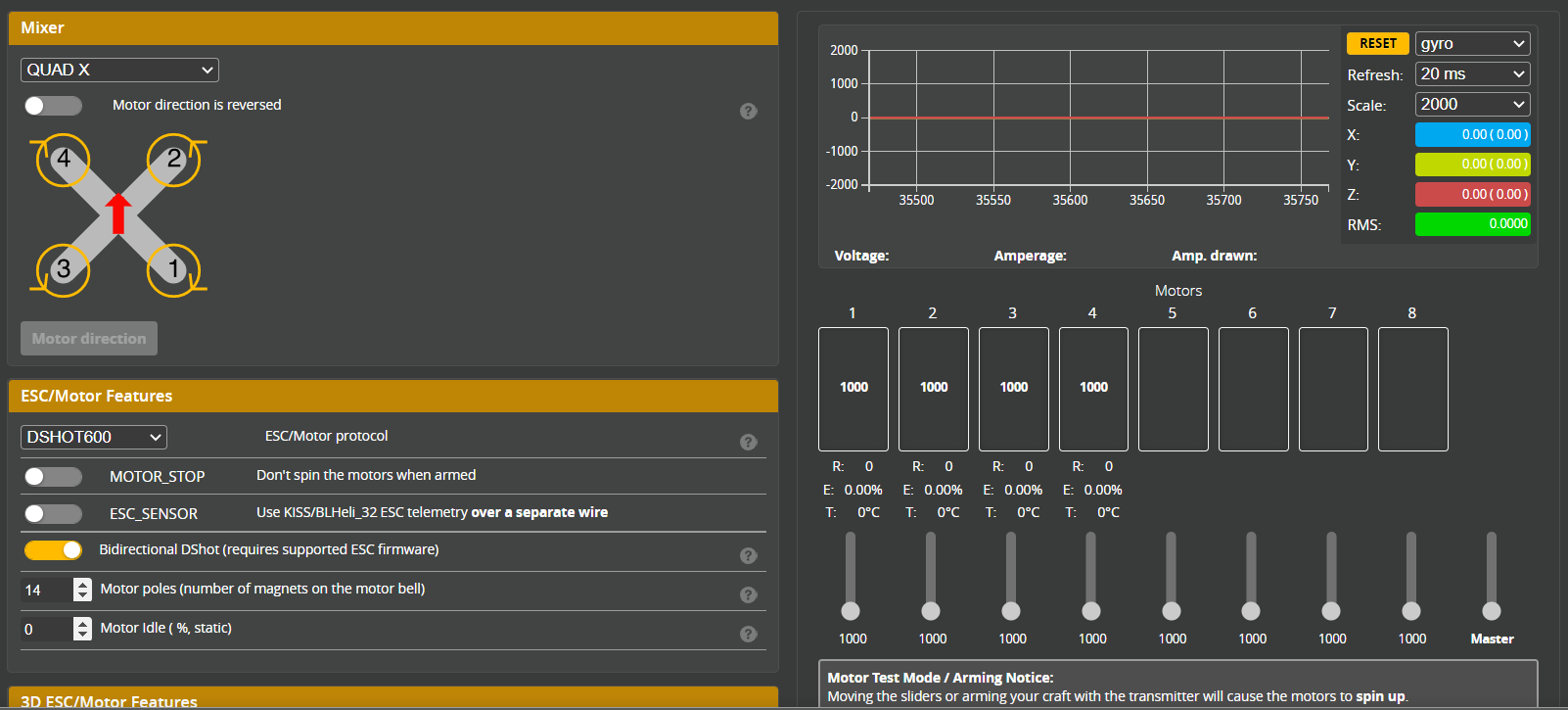
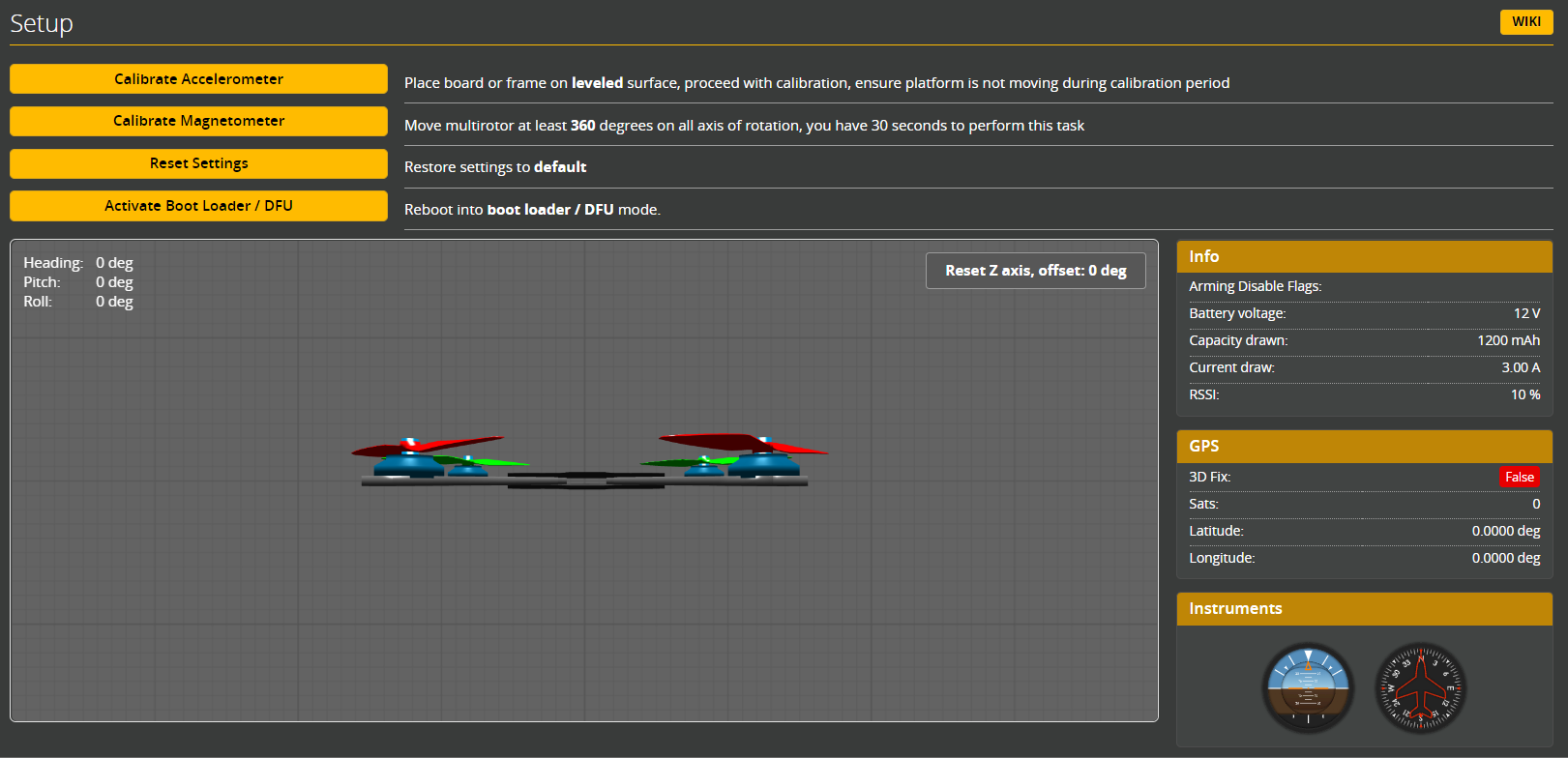
After building the initial drone, I collaborated with a colleague during the academic year to push the limits of its functionality. We developed a new custom flight mode in Betaflight that leveraged the drone’s onboard accelerometer to maintain stable hover with the propellers aligned vertically. This required digging into Betaflight’s C++ codebase—something I had no prior experience with. While my colleague led much of the software development, I was closely involved in learning the firmware architecture, PID tuning, and embedded sensor calibration.
This project was my introduction to real-time flight control systems, custom tuning, and how drones could be used for advanced applications—particularly in defense. It reinforced how critical hands-on projects are in understanding flight physics, control theory, and embedded programming.
DESIGN & DEVELOPMENT
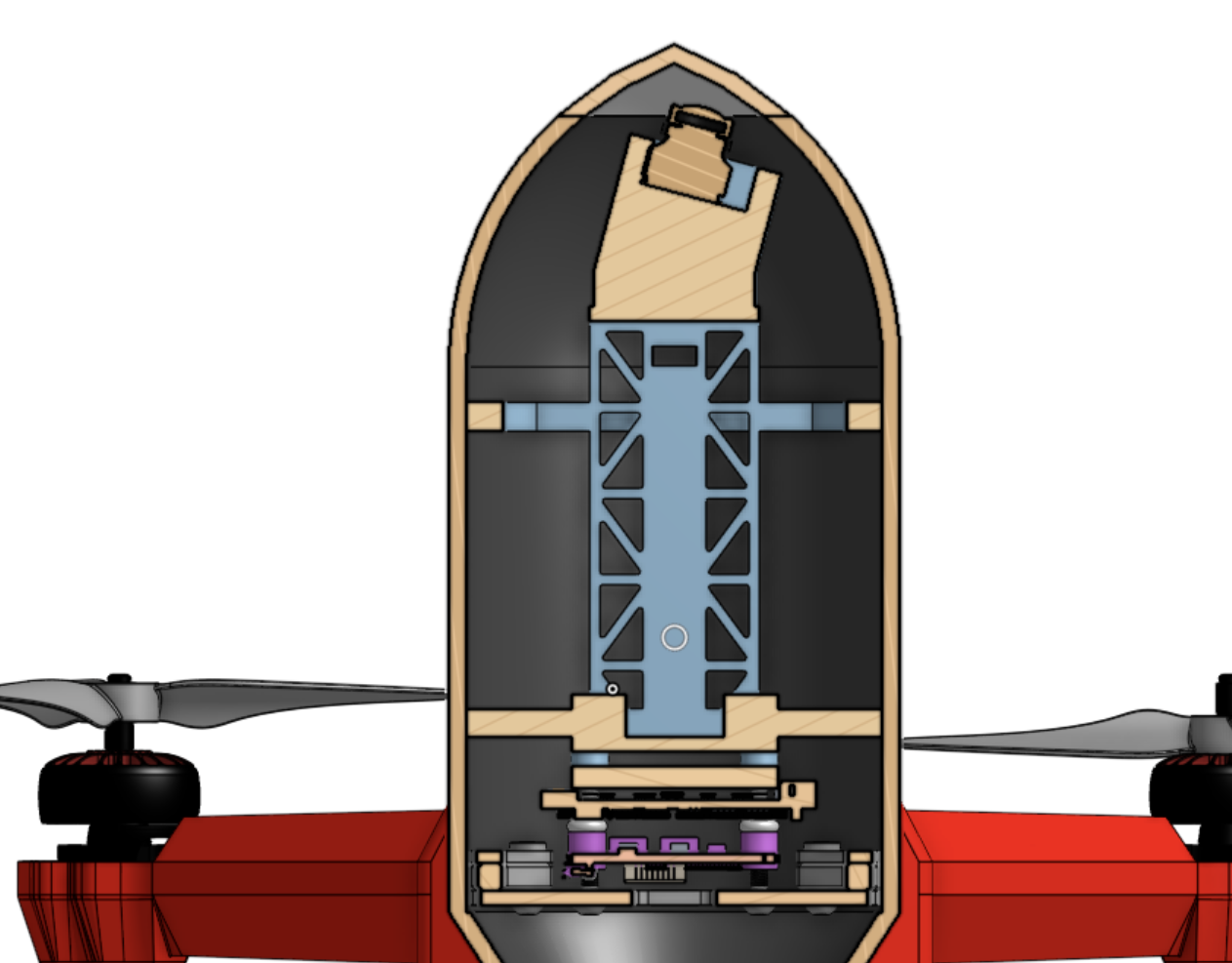
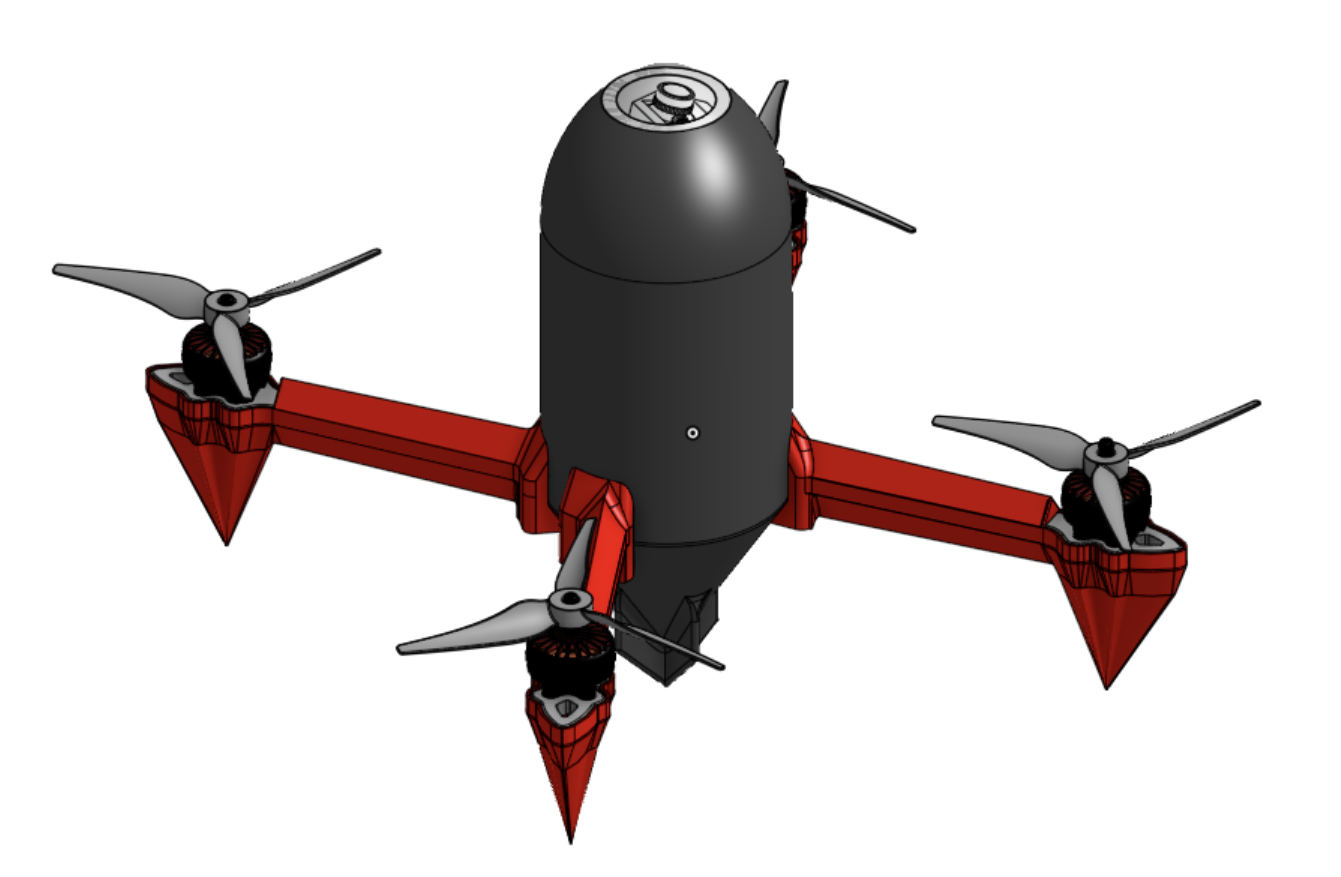
During the following summer, with a bit more time between my coursework and research commitments, I returned to the drone. I created the full CAD model, incorporating lessons learned from the earlier prototype and aiming for a more aerodynamic, integrated design.
The drone is currently designed for rapid prototyping using ABS plastic via 3D printing. The top opaque housing is actually a clear plastic window designed to protect and provide visibility for a Foxeer FPV camera. Inside the fuselage, a layered architecture houses the electronics:
Flight Stack: A MAMBA MK4 ESC and flight controller are mounted at the base.
Video Transmission: Above the flight stack is a Rush Ultimate II video transmitter.
Battery + Camera Assembly: Sitting above everything is a 3D-printed “seat” designed to secure a 22.2V 1300mAh OVONIC LiPo battery and the Foxeer camera. Channels and grooves in the design allow wires to be neatly routed for both power and video feeds.
The drone’s arms feature top-and-bottom mounting points for enhanced rigidity and reduced drag. While a rear tail fin was added to support directional stability, the FC’s internal gyros and the quad-motor configuration will do the majority of stabilization work.
To minimize wobble and improve structural alignment, the battery seat is centered within the fuselage using concentric 3/4 circle braces.
NEXT STEPS
The next major milestone is to 3D print the airframe and begin flight testing. This will involve validating the flight characteristics, ensuring the drone’s control system behaves as expected in hover and forward flight, and adjusting PID gains to fine-tune responsiveness.
Upgrades will follow—starting with replacing the limited-range goggles and video transmitter system to enable longer-distance flights. In the longer term, I plan to rebuild the fuselage using forged or layered carbon fiber to improve strength while reducing weight, further enhancing flight time and durability.
This project continues to be a technical playground for me, offering an opportunity to merge mechanical design, electronics integration, and flight software development in a single platform. Ultimately, it represents a growing personal interest in drone technologies and their broader applications in defense and aerospace.